
September 3, 2025 Breakfast Meeting Notes
Our guests today were speaker Karen Testerman, her associateTrisha Jorgensen and Mike Sun (who has applied for membership).
The 50/50 was won by Mike Sun.
Jake got to draw in the card game but selected the 3 of diamonds.
Denise spoke about service opportunities. She has picked up birthday cards for the nursing home and Mike will give her the contact information. She passed around several signup sheets. The first was for our Ending Hunger project, which will be on September 20 from 9-5 at the Senior Center in North Conway. Volunteers will be packaging shelf-stable meals and we will bring back 400 meals for the Senior Center and Plymouth Area Community Closet.
The second signup sheet was for October 4, Plymouth Pride Day, at the Rotary Amphitheater. It will be held from 12-4, with setup starting at 11:30. We can hand out lemonade and promotional literature. Wear your Rotary swag.
The final signup sheet was for Paradise Point Nature Center on Wednesday, Sept 10, right after our breakfast meeting. There will be a project to help move 4 canoes, 5 kayaks, and 2 tandems about 300 feet up a steep, rocky hill. Wear appropriate footwear.
The service committee will be meeting on the 9th and Denise will send out a Zoom invitation. There is also a district training opportunity coming up on October 18. Location will be announced later but save the date.
Hubbard Brook will have a photography workshop on the 8th of October at 10 am; bring a snack, a camera, some mud boots and bug spray.
Public Image committee meeting will be Monday Sept 8 on Zoom. Mike will send out a link.
Tony then presented his famous NH Trivia, My Island in the Sun edition.
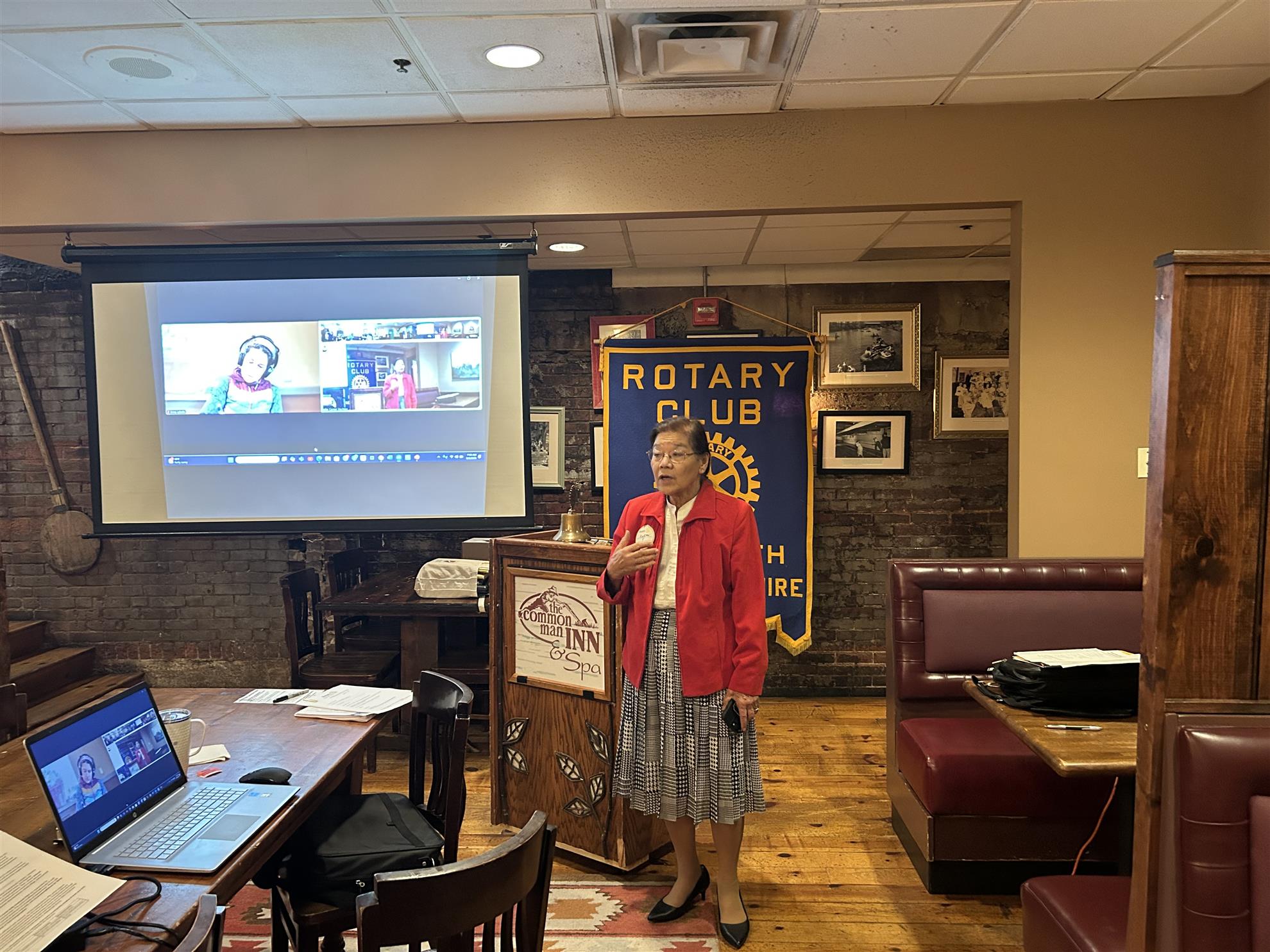
Karen Testerman speaks to the club.
Sharon introduced Karen Testerman, speaking to us today about the New Hampshire Veterans Administration. She noted that we give breaks to veterans in our stores, and honor them in many ways…but we don’t provide them with basic service the way we should. In 2022 the PACT act expanded the health services available to the veterans and included coverage for toxic chemicals.
When a veteran applies for disability in New Hampshire, it takes several months (120 days) for the application to be processed. Once processed, it can provide financial support for service-related disability. Filling out these forms is complicated and it’s easy to make mistakes, which is why it’s critical for vets to get help from Veteran Service Officers or VSOs. These VSOs are hired and trained by the state Department of Veterans Affairs, but sadly we only have 7 of these trained people for the entire state and its population of approximately 90,000 veterans. In Massachusetts, in contrast, there are 281 people doing this job for 253,000 vets. As a result, each VSO in Massachusetts services a little over 1000 people, while our New Hampshire VSOs each serve 13,300+ veterans. Furthermore, veterans’ survivors are also eligible for benefits, and the VSO officers also have to serve them. This situation can lead to long waits in accessing care, and this can have serious or even fatal consequences for the veterans.
We need to increase the number of VSOs in NH to at least 20 in order to better handle this large number of clients. Some vets wait 3 months or more in order to get into the program. Rotarians can help by making phone calls or writing letters to state officials. We can also bring publicity to the general public by calling radio stations, writing letters to the editor, and talking to our friends…spreading the word is critical. Karen provided us with the handout below to aid us in contacting our representatives.
Happy dollars were shared by Mike, Bill, Tony, Denise, Karen.
Bill announced that Hiltz Construction has donated $1000 for the Penny Sale.
Respectfully submitted,
Lora Miller, secretary
Honored But Underserved: The Unmet Needs of New Hampshire’s Veterans
Karen Testerman
Last year, New Hampshire Secretary of State David Scanlan promoted the “Vote in Honor of a Veteran” initiative, offering residents an opportunity to publicly recognize the service and sacrifice of military veterans who protect the freedoms we all enjoy. While this gesture of respect is commendable, it highlights a painful contradiction: despite widespread praise and public gestures, New Hampshire is failing to meet the practical needs of its veteran population.
https://www.sos.nh.gov/vote-honor-veteran
A recent analysis by Smilehub.org ranked New Hampshire 15th among U.S. states in terms of overall support for veterans. While the state performs well in areas such as veterans' finances and employment opportunities, it lags significantly in key areas like community support, health care access, and quality-of-life measures.
https://smilehub.org/blog/states-that-care-the-most-about-veterans/161
Navigating the Department of Veterans Affairs (VA) system is notoriously complex. Veterans often begin this journey during times of physical pain, emotional strain, and financial uncertainty. At such a vulnerable moment, they need expert guidance. That’s where Veteran Service Officers (VSOs) play a critical role. These professionals are trained to help veterans access the benefits they’ve earned, ensuring proper documentation, timely filings, and essential advocacy.
Unfortunately, in New Hampshire, only seven state-employed VSOs are responsible for assisting nearly 90,000 veterans across the state. This severe staffing shortage results in wait times ranging from a few days to several months just to schedule an appointment. Worse still, veterans must travel to one of only ten locations statewide, with no accommodations for those who are hospitalized, disabled, or lack transportation.
Although volunteer VSOs affiliated with veterans’ service organizations offer some support, they often lack sufficient training and access to the VA’s internal systems. During a February 2025 meeting with Deputy Adjutant General Nicole Deslient-Bixler and Representative Michael Moffett, State VSO Director William Gaudreau expressed deep concern over the limited training of volunteer VSOs. He emphasized that veterans should seek help only from state-employed VSOs—despite the state’s inability to provide timely or widespread access.
By comparison, Massachusetts law mandates that every municipality employ at least one VSO to serve its local veteran community. Consider the disparity:
Metric | New Hampshire | Massachusetts |
Total Veterans | 89,294 (#41 nationally) | 253,731 (#24) |
Veterans per 100,000 Residents | 6,307 (#6 nationally) | 3,523 (#46 nationally) |
State VSOs | 7 | >250 |
This means each New Hampshire state VSO is responsible for over 12,000 veterans—a workload that is both unsustainable and likely to increase as benefits expand under legislation like the Promise to Address Comprehensive Toxics (PACT) Act of 2022, which broadens eligibility for VA assistance and survivor compensation.
Critically, expanding the number of trained VSOs is not just a moral imperative—it’s also economically sound. When veterans successfully access their federal benefits, those funds are typically spent within their communities, supporting local businesses and contributing to the state’s economy.
Despite these realities, state officials cite budget constraints as the primary barrier to hiring more VSOs. As Gaudreau noted in February, “We fought hard to expand from five to seven.” That modest gain is clearly not enough.
If New Hampshire genuinely values its veterans—not just in ceremony, but in substance—it must invest in the personnel and infrastructure required to support them. The time for symbolic gestures has passed. We must align our policies and resources with the respect we so often express.
It’s time for New Hampshire to match its words with action and ensure our veterans are not just honored—but truly served.