March 11, 2026 Breakfast Meeting Notes
Guests: JP from Finland, who lives locally now! He was a Rotary exchange student in 1982 in Massachusetts and met his future wife there! Our other guest was our speaker Daniel Sherman, the clinical services officer at Speare.
Dan Sherman won the chance to draw in the card game but he didn’t have any better luck than the rest of us have been having! We have 13 cards remaining including 2 jokers.
Rotary weekly highlights: Last week we had round 2 of the speech contest; it was fun and we had great speakers. Ben went to PELS in Framingham this past weekend. This is a multi-day event to help presidents understand the club process, how to work with other Rotary groups, and learn other things that they need to serve effectively. One speaker spoke about how important it is to express gratitude to our coworkers. Ben came to realize that our club really pulls together and participates much better than some other clubs, so he wanted to express his gratitude to all of us. Ben was also struck by the energy and enthusiasm of our district leadership. Denise will now be covering two additional clubs under her assistant DG umbrella. She also won a basket of goodies at PELS and she held a drawing to distribute the contents to our club members.
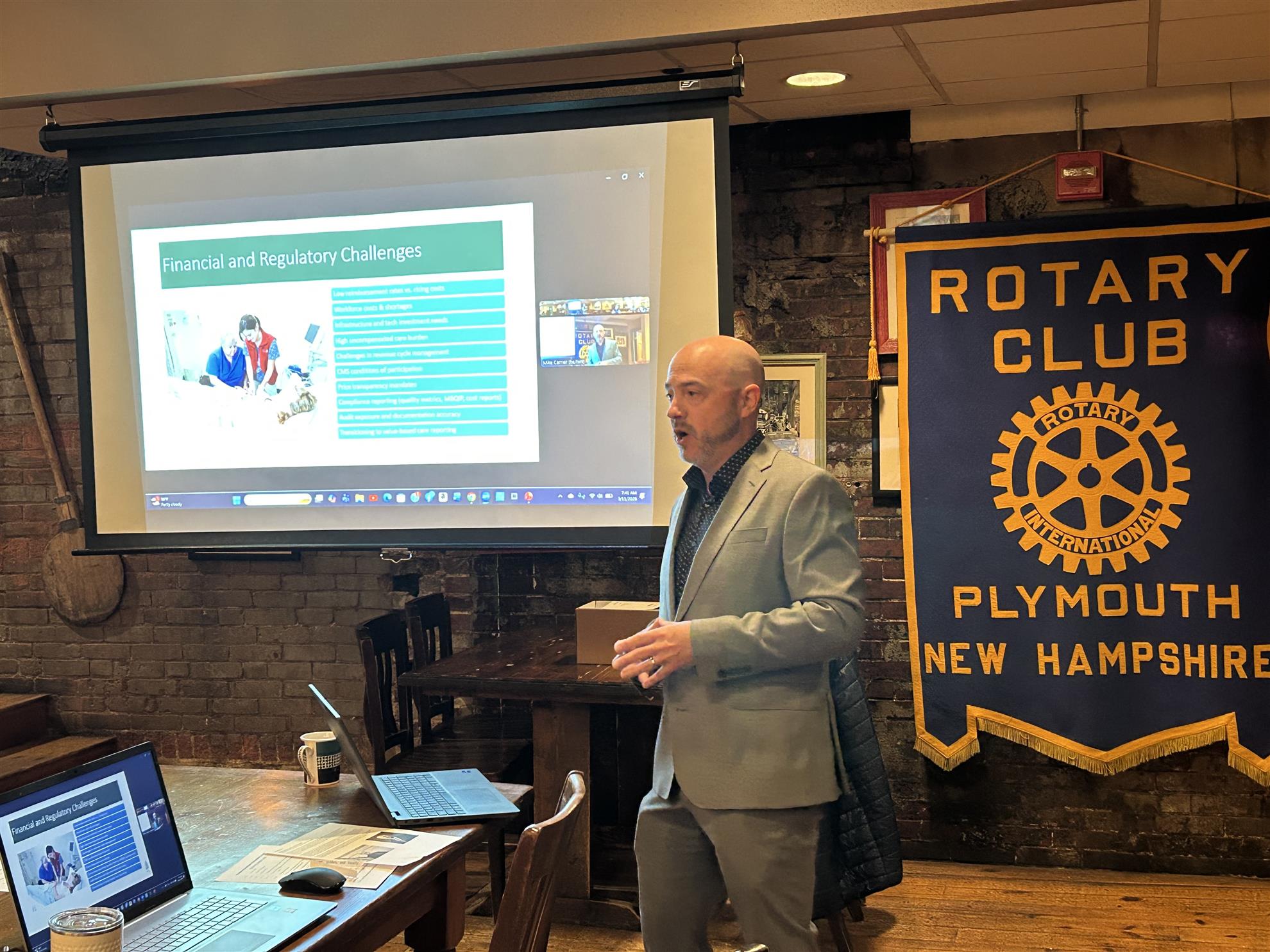
Today's speaker, Dan Sherman of Speare Memorial Hospital.
Ken Evans introduced our speaker. Last year Walter invited Ken to join the board of Speare and he was happy to volunteer. He has learned so much about how Speare is important to the fabric of our area and community. Today he asked the Chief Clinical Services Director at Speare, Dan Sherman, to speak to us. Dan is responsible for about half of the revenue generated by Speare. Ancillary services such as x rays are a source of revenue and are vitally important to the community. Having a local, independent hospital allows for local control of decisions, forging strong community trust and providing for flexibility of care.
Health care has been a hot-button item for discussion for a long time. It is very important to maintain a healthy local medical facility, particularly in a rural area such as ours. As clinical services officer, Dan oversees all of the diagnostic and therapeutic services at the hospital, such as x rays, MRI, pathology, medications and pharmacy, cardiac and occupational rehab, sleep medicine, and others.
In 1997 rural hospitals were closing all over the country, because they don’t have the volume of patients to provide 24/7 care. So a law was created for hospitals tin areas with few health services to be designated as Critical Access Hospitals, and Speare has received this designation. Under this law Speare is required to have no more than 25 beds. Maximum length of stay is 96 hours, so someone needing longer term care is sent elsewhere. The hospital needs to maintain 24/7 staffing. Medicare pays on a cost-based reimbursement to Speare, and we are paid 101% of those costs the following year.
There are 13 Critical Access Hospitals in New Hampshire. Most of these are members of a larger regional system. By 2027 there will be be only 3 independent community hospitals left in the state. These have community boards and local community control.
The history of Speare: In 1899 the Emily Balch Cottage hospital was founded. In 1940 p local philanthropist, Steve Speare, donated $50,000 and by 1951 the hospital was built at a cost of al little over half a million dollars. ER and outpatient services were added in 1996 and 1998. In 2006 the hospital constructed a 23,000 square foot addition.
The mission of Speare is to work together to serve the needs of our patients and community. The hospital’s vision is a community where all can achieve optimal heath. The values promoted by the hospital include kindness, collaboration, patient and family-centered, care, safety, excellence, efficiency, and professionalism.
Speare offers a wide variety of practices, including primary care, orthopedics and sports medicine, pediatric medicine, ob/gynecology, Plymouth general surgery, podiatry, White Mountain eye care, weight management center, sleep medicine, wound care, as well specialty practices in the new facility in Meredith. The hospital is one of only two int the area to offer a birthing suite, as well as cardiac rehab, urgent care, emergency department, laboratory services, nutrition, oncology, optical care and others.
In order for a small hospital to survive, it must partner with outside groups. Speare partners with Cardiovascular specialists of New England, Concord orthopedics, Dartmouth cancer center, Dartmouth obstetrics for high risk patients, Dartmouth tele pharmacy, Dartmouth pathology, as well as Medstream for anesthesia and Southern NH Radiology.
Despite these partnerships the hospital still faces financial challenges. Starting in 2019. costs were rising and reimbursement declined, posing huge challenges. A lot of these challenges are in the personnel area, so they have to hire a lot of high paid traveling employees. Technology costs are also increasing. Uncompensated care is a big problem. Collecting and billing is also very complicated. Price transparency mandates pose a challenge; it’s not as simple as asking what a procedure will cost. Compliance monitoring is also difficult to afford. Hospitals today are asked to provide value based care, which means putting the burden of maintaining affordability in the hands of the providers. Practitioners must be careful in how they work diagnostics and avoid running extra tests that aren’t necessary. They also monitor outcomes so as to be sure that patient care is not compromised.
Recent cuts to medicaid and work requirements have increased administrative costs and led to more uninsured patients, as has the loss of ACA premium subsidies. A Medicaid Enhancement Tax is paid by every hospital; caps on a federal match to MET paid to each state causes problems. The state is supposed to send these MET payments back to hospitals as a source of revenue but it frequently just uses the money to augment the general fund, leaving hospitals in the lurch. Speare does have a high percentage of Medicaid patients and so is relatively well reimbursed. Dan noted that the same payment is given to any provider for the same service, regardless of the provider’s overhead.
Speare has strategic priorities to provide excellence in care, maintain financial strength, hiring the right people and culture so they get good people, providing a patient experience that is exceptional, and expanding the brand. Ideally they want to be the first choice for care in our area.
Speare tries to get patients in for regular followups.The hospital is working on its financial strength via use of AI and other technology, rewarding staff for high performance, creating a brand promise that you will receive a certain experience when you get treated at a Speare facility, and providing self service technology in booking appointments on line. The ho0spital is also focused on brand expansion, providing more facilities to get quick access and underserved areas (such as Meredith and Moultonboro).
Speare also wants to expand their philanthropic footprint and see how they can partner with other local businesses to support the hospital’s mission.
NH was granted $2.4 million for rural heath delivery over the next 5 years. Local and federal grants support hospital expansion. Philanthropy is important.
We will hold election of officers and discuss the Citizen of the Year next week.
Happy dollars were shared by Mike, Denise, Ben, Tony, and Steve.
Ben announced that the Granite state challenge will be featuring the Plymouth Bobcats quiz bowl team. Be sure to watch!
Respectfully submitted,
Lora Miller, secretary
